CHINESE ACADEMY OF SCIENCES

-

- First pulsar polarization array limits on ultralight axion-like dark matter
- (NO.232 February 2026)
- Issue NO:Research Progress Updated:09-03-2026
Recently, Professor Ren Jing from the Institute of High Energy Physics of the Chinese Academy of Sciences (CAS), along with collaborators and in partnership with the Parkes Pulsar Timing Array (PPTA) collaboration in Australia, successfully performedthe first-ever “pulsar polarization array” (PPA) analysis to detect ultralight axion-like dark matter.Byleveraginglong-term polarization data from the PPTA, the research team established the most stringent observational upper limits to date on the Chern‑Simons coupling strength between ultralight ALDM and the electromagnetic field within the “fuzzy” mass range. The findings were published in Physical Review Letters(Phys. Rev. Lett. 136, 011001 (2026)) on January 7 and were selected as an “Editors’ Suggestion” paper. For nearly a century, dark matter has posed one of the most profound mysteries in cosmology. Ultralight ALDM stands out among potential candidates due to its unique wave-like nature on astronomical scales, stemming from its minuscule mass. The PPA, a network of linearly polarized pulsars within the Galaxy, is exceptionally suited for detecting ultralight ALDM by cross-correlating pulsar polarization data. Due to “cosmological birefringence”, an effect induced by the ALDM Chern-Simon’s coupling, the linearly polarized light of PPA pulsars is predicted to ripple with a distinct wave-like oscillation, while traveling inside the Galactic halo.Building on nearly two decades of polarization observations from the Parkes Pulsar Timing Array, the research team systematically conducted the first search for ultralight ALDM using a pulsar polarization array. To accomplish this pioneering task, the team developed an advanced Bayesian analysis framework that involved constructing time series of pulsar polarization angle residuals, establishing an effective noise model, and performing cross-correlation analyses between pulsars. The results show that the constraints on the Chern‑Simons coupling strength provided by the Parkes PPA surpass all previous limits based on axion-like dark matter hypotheses over a broad mass range, particularly setting the most stringent bounds in the “fuzzy” mass region. The study also demonstrates that cross-correlation analysis between pulsars plays a crucial role in discriminating the nature of potential signals. This work marks a leap forward in using novel astronomical methods to explore the nature of dark matter.
The co-first authors of the paper are Dr. Xue Xiao from the Barcelona Institute of Science and Technology, Spain, and Dr. Dai Shi, the Parks Lead Scientist, Australia. The corresponding authors are Professor Liu Tao from the Hong Kong University of Science and Technology and Professor Ren Jing from CAS’s Institute of High Energy Physics.
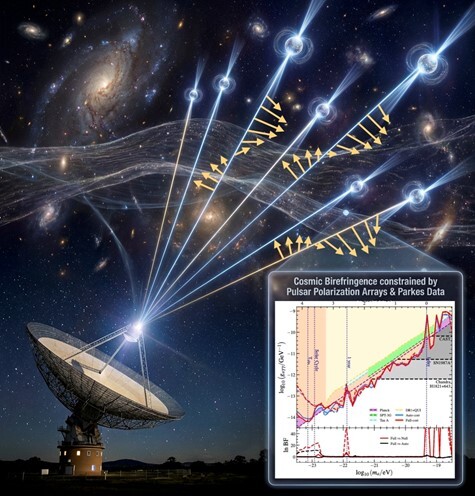
By cross-correlating pulsar polarization data within the galaxy, the PPTA collaboration sets the most sensitive limits on how strongly “Fuzzy” axionlike dark matter can interact with Chern-Simons coupling. [IMAGE:IHEP]
For more information, please contact:
Jia Yinghua
E-mail: jiayh@ihep.ac.cn
Institute of High Energy Physics,
Chinese Academy of Sciences
Source: Institute of High Energy Physics,
Chinese Academy of Sciences