CHINESE ACADEMY OF SCIENCES

-

- Atomic-scale control of quantum interference achieved
- (NO.229 November 2025)
- Issue NO:Research Progress Updated:03-12-2025
A research team led by Professor Yang Kai at the Institute of Physics (IOP) of the Chinese Academy of Sciences (CAS), in collaboration with Professor Fernández-Rossier Joaquín from the International Iberian Nanotechnology Laboratory, has demonstrated all-electrical control of quantum interference in individual atomic spins on a surface, opening new possibilities for fast and robust quantum-state manipulation at the atomic scale.
Quantum interference is a hallmark of the wave-like behavior of quantum particles. It arises when a system exists in a superposition of states, with the relative phases producing constructive or destructive interference. A prominent example is Landau-Zener-Stückelberg-Majorana (LZSM) interference, which occurs when a two-level system is repeatedly driven through an energy-level anticrossing, leading to multiple non-adiabatic transitions and controllable interference patterns. This mechanism is a powerful tool for fast and reliable quantum control, but it remains a significant challenge to achieve tunable LZSM interference in an atomic-scale quantum architecture — where multiple spins can be precisely assembled and controllably coupled on demand.
Using a custom-built advanced microscope known as Electron Spin Resonance-Scanning Tunnelling Microscope (ESR-STM), the team developed an all-electrical method to control LZSM quantum interference in individual and coupled atomic spins on insulating films (Figure 1). By modulating atomically confined tip-atom interactions with strong electric fields, they rapidly drive spin states through anticrossings and observe rich interference patterns, including multiphoton resonances and signatures of spin-transfer torque. Multi-level LZSM spectra of coupled spins reveal how many-body energy landscapes shape quantum dynamics. These results open new avenues for all-electrical quantum manipulation in spin-based quantum processors in the strongly driven regime.
This study entitled “Electrically tunable quantum interference of atomic spins on surfaces” was published in Nature Communications.
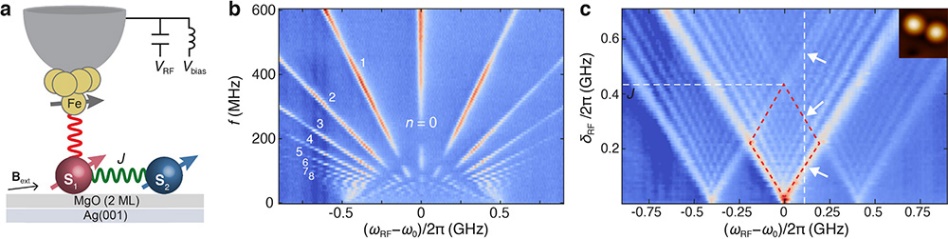
Figure 1. Quantum interference observed in a single spin and a pair of interacting spins. [IMAGE: IOP]
For more information, please contact:
Professor Yang Kai
E-mail: kaiyang@iphy.ac.cn
Institute of Physics,
Chinese Academy of Sciences
Source: Institute of Physics,
Chinese Academy of Sciences