CHINESE ACADEMY OF SCIENCES

-

- University of Chinese Academy of Sciences unveils School of Space Exploration
- (NO.232 February 2026)
- Issue NO:Lead Updated:09-03-2026
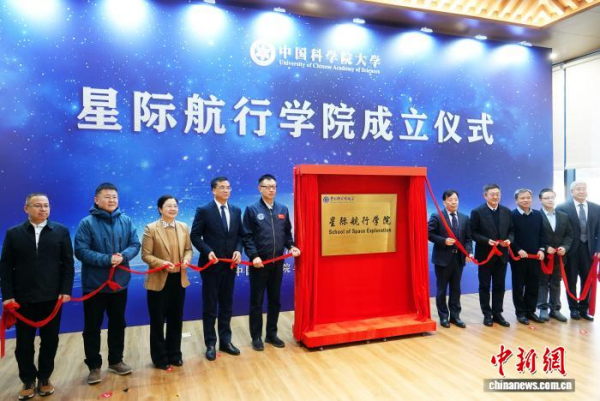
On January 27 in Huairou District, Beijing the inauguration ceremony of the School of Space Exploration at the University of Chinese Academy of Sciences (UCAS) is held at the Chinese Academy of Sciences (CAS) and the “Two Bombs, One Satellite” Memorial Hall. [IMAGE: China News Service]
In 1957, Qian Xuesen, a founding father of China’s “Two Bombs, One Satellite” project, proposed the idea of establishing a school dedicated to space exploration. Nearly 70 years later, this vision has become a reality. On January 27, UCAS officially unveiled the School of Space Exploration at the memorial hall in Huairou District, Beijing—setting sail from a birthplace of China’s space program and the “Two Bombs, One Satellite” spirit.
The next 10 to 20 years represent a critical window for leapfrog development in China’s space exploration sector. Fundamental original research and technological breakthroughs will reshape the landscape of deep-space exploration and determine national core competitiveness. The establishment of the UCAS School of Space Exploration will provide strong talent support for China's major strategic needs in deep-space exploration and space science research.
Zhou Qi, Vice President of CAS and President of UCAS, noted that as humanity advances toward the Moon, Mars, and beyond the solar system, the School of Space Exploration must develop its own strategic vision, planning, and long-term blueprint.
Zhu Junqiang, Director General of CAS’s Bureau of Major Science and Technology Projects and the Bureau of Strategic High-tech Development, has been appointed Dean of the School. He stated that the School of Space Exploration will be developed into three major hubs: a center for foundational aerospace research within CAS, a hub for cultivating high-level innovative talent, and a platform for open international academic exchange.
In November 2025, UCAS decided to establish the School of Space Exploration. It will build a curriculum system covering 14 first-level disciplines and program categories, including aerospace science and technology and planetary science. On the basis of 97 existing courses, 22 new core courses will be added, covering frontier areas such as space power and propulsion principles, perception and utilization of the space environment, planetary dynamics and habitability, and space sociology and governance—achieving deep integration of science, technology, and application.
In terms of teaching practice, the School will rely on three types of existing platforms in Beijing Huairou Science City—frontier science, key technologies, and strategic applications—and will also establish six distinctive platforms, including an intelligent unmanned aerial vehicle patrol simulation platform, a full-process teaching and practice platform for space science satellites, and an interstellar flight ground–space coordinated experimental teaching and innovation platform, providing students with an immersive training environment.
Following the unveiling ceremony, the first plenary meeting of the Teaching and Training Steering Committee for the Space Exploration Talent Cultivation Program was also held on the same day.
Source: Chinese Academy of Sciences