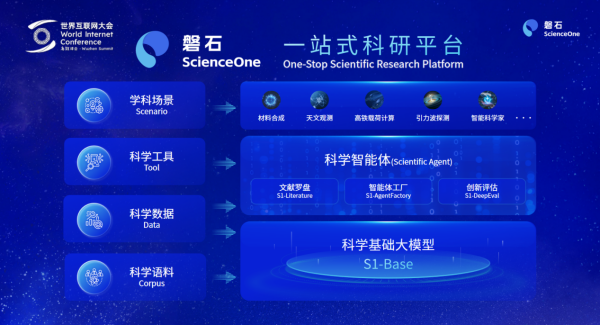
The one-stop scientific research platform “ScienceOne V1.5”, developed by a joint team from the Chinese Academy of Sciences (CAS), was released at the 2025 World Internet Conference Wuzhen Summit on November 9. This version represents a significant advancement from “ScienceOne V1.0” released on July 26. The platform has already facilitated a series of breakthroughs in cutting-edge research across multiple disciplines, including astrophysics, energy materials, and mechanical engineering.
In astrophysics, addressing the challenges of high computational costs and complex workflows in stellar parameter inversion, the team collaborated with CAS’s National Astronomical Observatories to develop an intelligent tool chain for the inversion of stellar parameter. This system significantly enhances inversion speed, improves the reliability, stability, and interpretability of results, and reduces computational costs and the barrier to use, enabling researchers from cross-disciplinary fields to easily conduct analysis and verification of stellar parameters.
In energy materials, aiming to move beyond the inefficient trial-and-error approach in material development, the team collaborated with CAS’s Shanghai Institute of Ceramics to develop “S1-MatAgent”, a fully automated, end-to-end material inverse design system. This system can autonomously conduct literature reviews, material calculations, and material optimizations.
In the field of mechanical engineering, addressing high cost and long cycles in fluid load calculations for complex configurations like high-speed railway and aircraft, the team partnered with CAS’s Institute of Mechanics to develop intelligent load calculation technology. This technology can successfully reduce the simulation analysis time for high-speed train aerodynamic problems from several hours to mere seconds, providing crucial data support for the configuration design and optimization of major equipment.
Source: CCTV News
WHAT'S HOT

